What goes on inside the head of an Elephant?
By Darryn Murray – Bushwise Mahlahla campus trainer
To see an African Elephant while out on safari is always an amazing sight and high up on most people’s bucket lists.
But even more amazing is what goes on beneath the skin. The skull of the African Elephant is a phenomenal work of nature. The cause behind this being the design and adaptations that it has undergone during thousands of years of evolution.
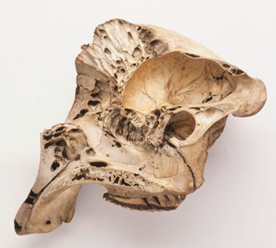
The skull of an African elephant cut in half for scientific research purposes, showing the honeycomb-like design of the bone as well as the large brain cavity near the back of the skull.
Unlike other mammals that have marrow filled bones, the Elephant has bones that are filled with a sponge-like bone tissue. This tissue aids in the support and structure of the bones while helping to reduce bone weight. The head of an African Elephant with all the associated muscles, trunk and tusks can weigh up to an astonishing 300kg.
The main part of the skull is made up of air cavities and a honeycomb like design, reducing the weight of the skull but not taking away from the structural integrity of it. Only the lower jaw is solid bone. The skull, alone, of the African elephant weighs on average around 50kg.
The brain of the elephant, which is housed at the back of the skull, well away from the forehead and almost in line with the auditory canal and is the largest known of any land animal to have ever lived on the Earth!
The growth and development of the brain are very similar to that of a human. Both are born with fairly small brain masses, however, the growth and development are rapid, giving way to greater learning ability, superior intelligence and a more sophisticated social structure.
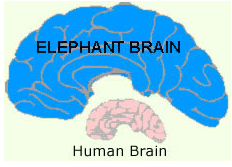
An amazing illustration of the relative size of a human and elephant brain. (The average elephant brain is between 3 and 4 times larger than the human brain, weighing between 3.5kg -5.5kg.)
So if the weight of the brain as well as the weight of the skull, only makes up roughly 20% of the total weight of the African elephant’s head, what accounts for the other 80% or 240 odd kilograms?
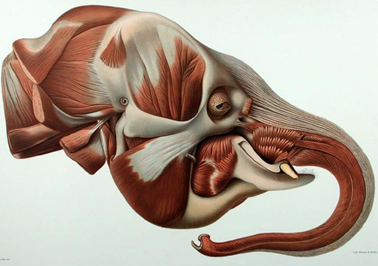
Illustration of the various muscles on the elephant’s head that it requires for range of motion as well as to keep the head upright.
Tusks: These are carried by both sexes of African Elephant, and studies show that the average weight per tusk is 25kg.
Trunk: Containing roughly 100 000 muscles and having a wide variety of uses for the animal from feeding to drinking to fighting and smell. The trunk alone can weigh as much as 140kg!
Teeth: The 4 large flat molars in an adult elephant’s mouth will weigh about 3.5kg each.
Muscles: The muscles that are required to keep the skull, trunk and other parts of the elephants head upright as well as giving it the range of motion that it requires to do what an elephant does will make up the remainder of the total weight, roughly 40kg.
To put all of this into perspective, the human head (including teeth, neck, muscles, brain eyes and skull) weighs in at a mere 3.5-5.5kg.
With the average elephant [brain] weighing roughly 50 – 60 times as much as that of the average human, it’s brain capacity is the highest in all animals. It is a well-documented fact that an elephant’s memory is incredible: years can go by without visiting a certain watering hole, but the matriarch will not fail in leading her herd to this (and other) water sources during times of drought.
There is still so much to be learned from these magnificent creatures, making it imperative that we conserve their habitat so that future generations can experience the same amazement at seeing an elephant herd on an African Safari.